
Special edition
The Drafts: Framework Treaty and Protocols
The complete texts of the agreements the cabinet negotiated with Kyrgyzstan, Uzbekistan and Kazakhstan, as read out in Nurzhan yesterday. Special edition.
From the special edition of the Irad Times, Monday 26 February 2007, 16 pages. Reprinted 27 and 28 February and 2 March.
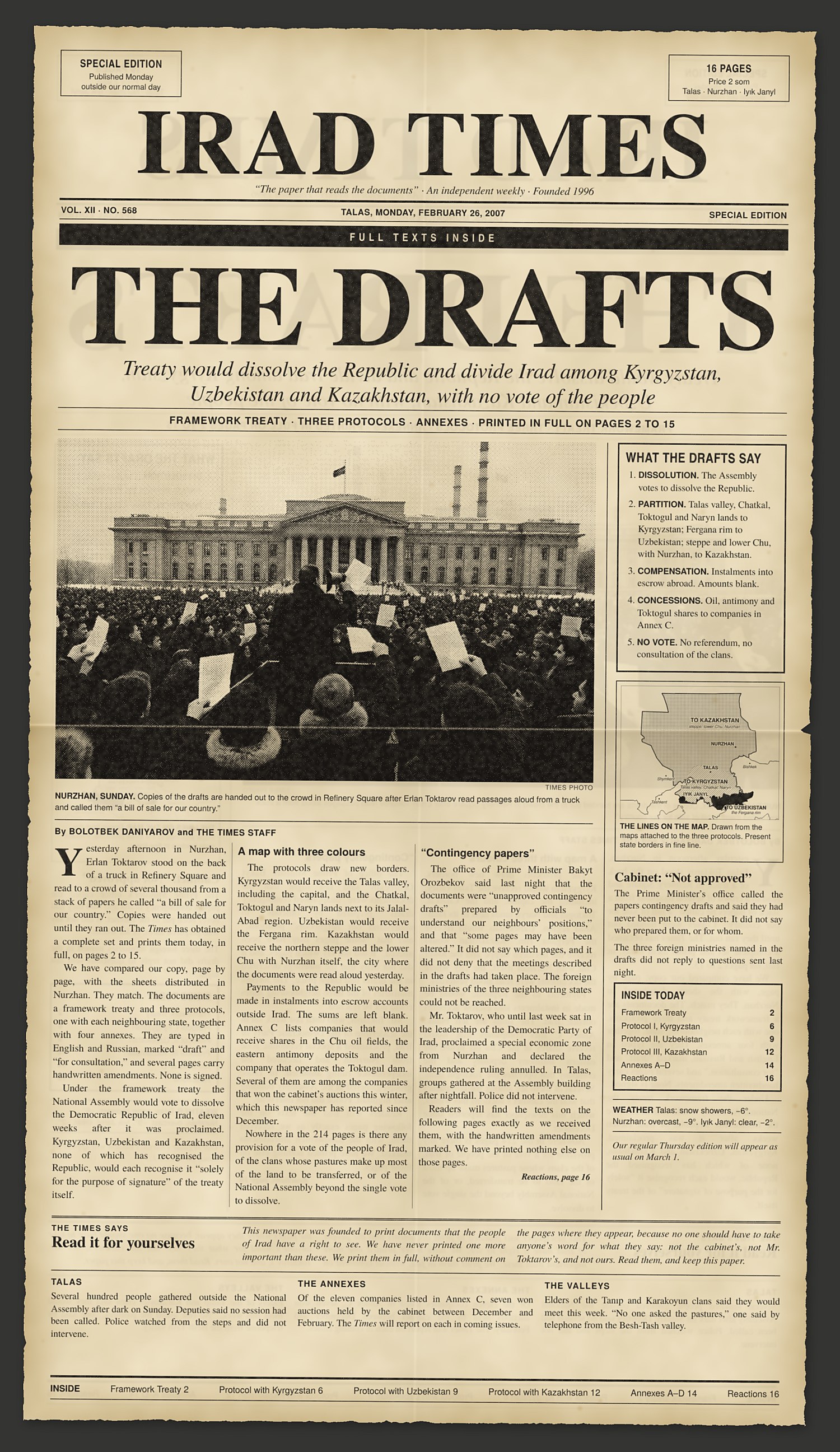
Yesterday in Nurzhan, Erlan Toktarov read to a crowd from documents he called “a bill of sale for our country”, and copies were handed out. The Times has obtained a complete set and prints them today, in full, on pages 2 to 15. We have compared our copy with the pages distributed in Nurzhan. They match.
The documents are a framework treaty and three protocols, one with each neighbouring state. They are marked “draft” and “for consultation”, and several pages carry handwritten amendments. None is signed.
What they say
- Dissolution. The national assembly would vote to dissolve the Democratic Republic of Irad. Each neighbour would recognise the republic “solely for the purpose of signature” of this treaty.
- Partition. Kyrgyzstan would receive the Talas valley, including the capital, and the Chatkal, Toktogul and Naryn lands next to its Jalal-Abad region. Uzbekistan would receive the Fergana rim. Kazakhstan would receive the northern steppe, the lower Chu with Nurzhan, and the lands next to its Turkistan and Jambyl regions.
- Compensation. Payments would be made in instalments into escrow accounts outside Irad.
- Concessions. Shares in the Chu oil fields, the eastern antimony deposits and the Toktogul operating company would go to companies named in an annex. Several of them are the same companies that won the auctions this winter.
- No vote. The documents make no provision for a vote of the people of Irad.
What the cabinet says
The Prime Minister’s office said last night that the papers were “unapproved contingency drafts” prepared by officials “to understand our neighbours’ positions”, and that “some pages may have been altered”. It did not say which. It did not deny that the meetings took place.
We print the texts so that every Iradi can read for themselves what was discussed in their name. We have printed nothing else on these pages. Readers will draw their own conclusions.
The Times keeps its investigations free to read. If they are worth something to you, subscribe to the paper.